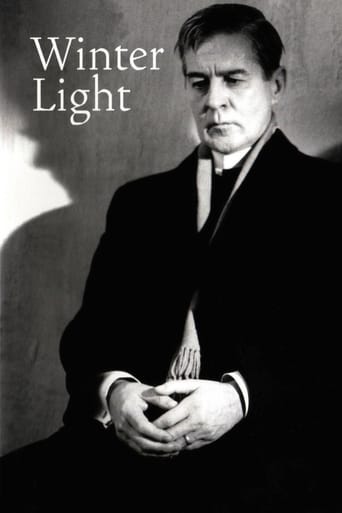
Diary Entry forWinter Light

Just didn’t really work for me like other Bergman films, I didn’t find it all that interesting and couldn’t invest myself into the story. The cinematography and shots are beautiful and I understand the concepts at work, I just wish I enjoyed this more than I did.
Other Diary Entries forWinter Light

Winter Light
Udah, gk mau maksain lagi nonton filmnya bergman✌🏻

Winter Light
سواءً كان مخرجي المفضل أو لا، سواءً كان أفضل من تابعت له أو لا، مستحيل أكن احترام لمخرج أكثر من بيرقمان مخرج علمني معنى السينما الحقيقية، السينما بدأت وانتهت بأنقِمار بيرقمان.

Winter Light
Pretty interesting movie. Not much to really say about it honestly, it was just good and had some excellent acting. 7/10

Winter Light
Faith manifests differently for every individual. For some, it resides in the hope and belief that those around them are kind and good; for others, religion offers a way to make sense of life’s uncertainties. I find myself somewhere in the middle, viewing religion not as an unshakable, absolute truth, but as a tool that shapes and guides our collective morality as a society. Winter Light marks my fourth film from prolific Swedish director Ingmar Bergman, and it may very well be my favorite of his so far. The film follows Tomas Ericsson (Gunnar Björnstrand), a country pastor grappling with his faith, identity, and a profound sense of disillusionment towards life. His feelings are rooted in the loss of his wife, the horrors he witnessed in Lisbon during the Spanish Civil War, and the looming shadow of nuclear annihilation. Ingmar Bergman’s approach to exploring this crisis of faith is both visually stunning and deeply personal. His connection to Winter Light is apparent—as this was the film that helped him come to terms with his own loss of faith—and his empathy towards the character of Tomas is unmistakable. At some point in life, we all confront a similar sense of existential reckoning, be it through religion or on a much more cosmic scale. Tomas could represent any one of us, regardless of what God we decide to believe in. Bergman manages to elevate the film through his masterful direction and evocative imagery. One moment, in particular, stands out to me: as Tomas reads a letter from his ex-mistress, Märta Lundberg (Ingrid Thulin), the camera cuts to a close-up of her as she recites the words aloud. It’s a brilliant way to trap us in that inescapable moment as Märta delivers a particularly scathing condemnation of Tomas. It’s a forced moment of self-reflection through the eyes of our lead. Faith is what we make of it, whether it’s preordained or forged through self-reliance. In the end, belief is a choice—our choice. We decide to believe that there’s meaning to it all, that we matter in the grand scheme of things. We decide to believe in good. It’s scary, placing trust in something so uncertain and formless. But if we don’t believe, who will?
Sign in to track, rate and review films
Sign in to track, rate and review films
