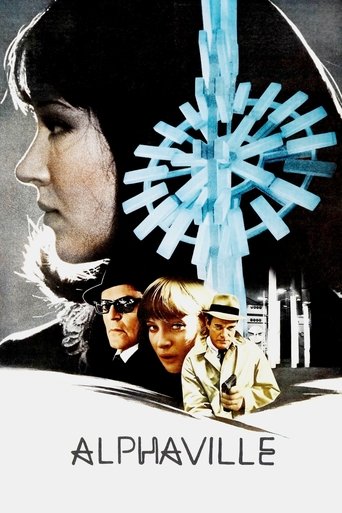
Diary Entry forAlphaville

A pretty wild time, Alphaville is like nothing I’ve ever seen before. The story is all over the place, yet there is a clear underlying message behind the madness. A bleak dystopian future which can only be saved by love. It’s pretty cool, the only bit I didn’t like is the age difference between Lenny Caution and Natacha Von Braun, which is a 23 year difference. Apart from that it’s a fun time with clever poems and riddles.
Other Diary Entries forAlphaville

Alphaville
“Do you know what turns darkness into light? Poetry.”

Alphaville
Ninguém viveu no passado. Ninguém viverá no futuro. O presente é a forma de toda vida O tempo é um rio que me arrasta, mas sou o tempo. É um tigre que me rasga, mas sou o tigre. Para nossa desgraça, o mundo é real. E eu, para minha desgraça, eu sou eu mesmo, Alpha 60 Longe, longe, diz o ódio. Mais perto, mais perto, diz o amor.

Alphaville
Alphaville | ALPHAVILLE, UNE ÉTRANGE AVENTURE DE LEMMY CAUTION dir. Jean-Luc Godard, França, 1966. O que é, realmente, Alphaville? Um documentário católico (Viver a Vida)? Um "policial" amador (Acossado)? A mentira 24 vezes por segundo (Uma mulher é uma mulher)? Ou teatro-verdade? A resposta é óbvia: uma colossal síntese de todo um cinema de síntese; – Rogério Sganzerla

Alphaville
"𝘖𝘶𝘪, 𝘮𝘢𝘪𝘴 𝘷𝘰𝘶𝘴 𝘢𝘷𝘦𝘻 𝘥𝘢𝘯𝘴 𝘭𝘢 𝘷𝘪𝘦, 𝘪𝘭 𝘺 𝘢 𝘲𝘶𝘦 𝘭𝘦 𝘱𝘳é𝘴𝘦𝘯𝘵 𝘱𝘦𝘳𝘴𝘰𝘯𝘯𝘦 𝘯'𝘢 𝘷é𝘤𝘶 𝘥𝘢𝘯𝘴 𝘭𝘦 𝘱𝘢𝘴𝘴é 𝘦𝘵 𝘱𝘦𝘳𝘴𝘰𝘯𝘯𝘦 𝘯𝘦 𝘷𝘪𝘷𝘳𝘢 𝘥𝘢𝘯𝘴 𝘭𝘦 𝘧𝘶𝘵𝘶𝘳." Everything I love about cinema. Editing. Melodrama. Poetic lines. Came back to this after almost a decade after returning to Murakami’s After Dark (https://www.goodreads.com/review/show/6547232192), which takes a bit of inspiration from. This hits a soft spot for me because it’s Godard doing film noir, yet still holistically himself. Proof that you don’t have to lose yourself when you enter a different genre, new territory. I also think his use of black and white here is beautiful, in that, at once, it obscures time, adding a timeless quality to the work at hand, but also playing into the motifs of German expressionism to leap it futures ahead. It’s the black and white Blade Runner (https://letterboxd.com/film/blade-runner/), if you will, without having to rely on special effects. Rather, Godard relied on the modernity of his own lifetime to extract the woes then to express the woes that still haunt us now. Though I think there’s too much of an American melodrama effect to the end, I wonder if this is satire on his part or if the script lost steam and strength, but love as a saving grace for both of our characters felt cheap, even if the absence of language, or the forgetting of language, is a core part of the film, which will then become a core part of Godard’s work at large. Perhaps then, this was him trying to answer the question that has always astounded him: “What comes after language?” Is it violence? And if so, could film noir answer the question for him? Do genres offer remedies or results in how we critique the world and the way it moves? To which Godard answers my question with his own answer: "To me, style is just the outside of content, and content the inside of style, like the outside and inside of the human body. Both go together. They can't be separated." 🥮🥮🥮 If you enjoyed this write-up, please consider purchasing my novella here (https://nathansnook.bigcartel.com/). Or find other thoughts on books and films here (https://www.youtube.com/@nathansnook/videos).
Sign in to track, rate and review films
Sign in to track, rate and review films
