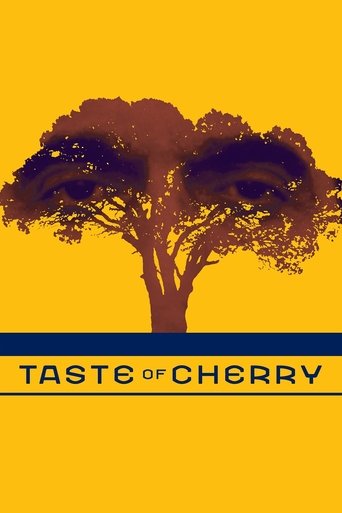
Diary Entry forTaste of Cherry

This is a hard film to really give an honest opinion on, as it’s so simple yet so complex it’s difficult to describe. I enjoyed the aspect of how grounded and real everything feels, I enjoyed the end where he finally considers if he has made the right choice, and I like how the film ends on a cliffhanger, as the point isn’t if he did it or not, it’s if he considered his life. I didn’t enjoy the build up much, I thought it was a bit too slow and it just didn’t really interest in truth. It’s a good film but maybe just not really one for me, I can understand why others see it as a masterpiece though.
Other Diary Entries forTaste of Cherry

Taste of Cherry
Proof that cinema doesn’t need noise to shake you to your core.

Taste of Cherry
Feels like reading a book
Taste of Cherry
I had the opportunity to catch this at my local indie theater about four weeks ago and the experience largely removed my words. There's the thought if I don't put something down for it I won't be able to word further. It pressed in on me. Not in any panic-inducing way, but more like the insistent pressure of a practitioner checking your abdomen for the point of soreness. The film is so direct and minimal in form, making the interior all but unavoidable, no other filmic detours or flourishes to distract me from having been in that car before, often to always. It's not an earth-shattering thing, not seeking tears or outpourings. Just that old dreadful chestnut of being known, right on down to the sleeping tablets. Such a thing harrows and relieves, an equalization of tension. There's a philosophic sureness to the structure, of the three avenues of life brushing against the resolve of Mr. Badii, but there is also a lower-level sharing-in and commiseration. To learn Kiarostami was very much directing from the driver seat and the passenger seat throughout, the movie continues to work on a level of pure empathy for me. I wonder about the Iranian context, or how such a scenario would play out in another more partitioned land. The space between individuals, and inside or outside the vehicle, feels so porous and free-flowing, so far removed from the more regimented and patrolled personal space of Western interactions. In spite of the main character's isolation, and maybe to even highlight it, there's a constant communion with the world. The small set-piece, for instance, where he inadvertently steers off the embankment and an entire group of nearby laborers flock down and coalesce in purpose to lift the car and its occupant back on track. Another moment where Mr. Badii rests amidst an active quarry, watching the machinery grind and pile up gravel, seeming to wish it were as easy to let it pile over him without the problem of having to convince someone to aid in his burial, and of course another stranger arrives and doesn't permit him to disappear in the dust. I feel there is something very important that the man whom Mr. Badii finally finds to carry out the burial task is also the one who had survived an attempt to end their own life and who also gives the most persistent plea against such an action. The immensity of it! "I beg you not to do this but I will absolutely be the one who will see this through with you." And then shortly thereafter Mr. Badii, and us, get out of the car for the longest time so far, the evening's softening colors and sounds being allowed a new, open consideration. Is there relief? A new anxiety? On his walk of the grounds overlooking the city, he passes by another figure on a bench framed in such a way that their view of the sunset seems barred by a lone, rectangular billboard in the background, looking for all the world like the lining of a grave. In earlier scenes, there are stationary long shots tracking Mr. Badii's car as it winds over the same stretch of road, sometimes disappearing from view behind the the rise and fall of the land. Through these repeated scenes, I gradually came to suspect the perspective is from the oft-visited gravesite itself, resolutely watching his comings and goings. The ending of the film deserves special recognition. The decision to step so far outside the narrative, of imagined structure, for me at least, was profound. Here is a continuation of the over-arching empathy, a connection to the real world and the real collaborations (communion?) required to achieve nearly anything in it. Living breathing humanity feeling all the same same things its characters do. The small action of the actor Ershadi offering a cigarette. The military group at rest, perhaps emblematic in one sense of obligated life and state-sanctioned death, but also calling back to some of the Mr. Badii character's most fond memories of purpose and belonging. The sudden tune of "St. James Infirmary Blues" fell like a weight on top of that, my own recognition of it thanks to the Fleischer Betty Boop "Snow White" cartoon and all its phantasmagoric imagery. Kiarostami has presented an unending landscape here, utterly grounded, and completely devoid of the tabloid approaches to its subject. I'm at a loss to find another viewing more personal, raw, or connective for me. I don't know that I can watch this film again, or at least not for a long time.

Taste of Cherry
A beautiful punch-to-the-gut; Taste of Cherry is powerful filmmaking that may be a bit challenging to get through, with slow pacing, but holds power in the simplistic storytelling. Excess is stripped away, leaving raw emotion laid out on the table. Kiarostami is in complete control of his audience, allowing us to travel on a spiritual journey alongside him. Kiarostami has already completely stunned me with two of his films, making me eager to see what else lies ahead in his filmography.
Sign in to track, rate and review films
Sign in to track, rate and review films
