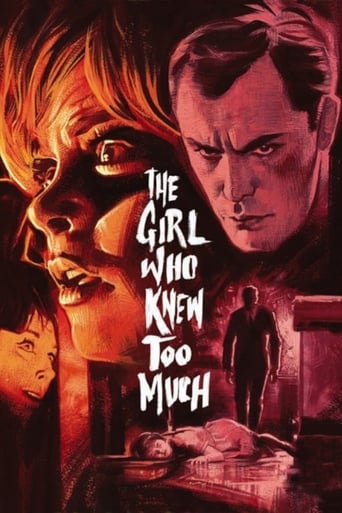
Diary Entry forThe Girl Who Knew Too Much

Seen by many as the first ever giallo film, The Girl Who Knew Too Much is a true masterpiece of cinema. Before writing this review I had no idea there were two versions of the film, the original Italian version and the US version. Luckily for me I watched the Italian version with subs, which seems to be by far the better offering. This noir thriller, which feels almost Hitchcockian at times, is a masterpiece of cinema, with beautiful suspense and such a good ending. Marcelo is an unlikeable love interest, but Nora Davis (played by Letícia Román) is such a good character. She’s clever, brave and solves the mystery. It’s a fantastic film well worth watching.
Other Diary Entries forThe Girl Who Knew Too Much

The Girl Who Knew Too Much
Mario Bava faz um exercício que flerta com o cinema voyeur de Hitchcock, mas abusa das sombras fantasmagórica de Joseph Loosey. Toda a idéia de fazer um live action de um romance policial com elementos do Gialli é muito fascinante. Ele tem toda a idéia de um romance policial meio vago a Norte Americano, mas ambientado, encenado e totalmente orquestrado em um cinema italiano. Ele tem passagens mais cômicas e gags visuais que diminuem a tensão, mas nunca o suspense. Todo o trabalho de sombras, luz contra-luz e contraste das imagens é algo surreal de incrível. Desde a apresentação do assassinato que Nora fica boa parte do longa duvidando de si mesma quanto a investigação que avança e se torna mais perigosa é algo genuinamente instigante. Tratar aquela casa como refúgio e armadilha funciona demais, uma espécie de exercício de linguagem com o gênero de casa assombrada e mesmo o grande assassino poder cair em uma reviravolta óbvia, em nada isso tira toda a construção de mundo macabra só através dos olhares. Medo, receio, espanto e incredulidade. Mario Bava abrindo com chave de ouro o Spookytouber!!!

The Girl Who Knew Too Much
The Mario Bava Challenge (http://letterboxd.com/butch_cassidy/list/mario-bava-challenge/) Nora is caught in a chain of frightful events. She's visiting Rome on vacation but hit by a bad first day; her sick Aunt dies, naturally afflicting Nora's state. The day gets more ailing when she witnesses the murder of a young woman, and a bunch of scoffs are thrown at her when she hysterically explains it. One doctor even diagnoses her with having delirium tremors. This prompts Nora, murder-mystery reader, to partially solve the murder herself. Mario Bava's The Girl Who Knew Too Much is widely treated as being the first genuine giallo film. Though it isn't laced with the intimate levels of brutality and stylish appearance seen in Bava's Blood and Black Lace, it nonetheless smartly accomodates a handful of well applied giallo conventions that now beckon an emphasis on the tenacity it possessed for its time. It's also quite a premature movie of the genre having not fully grasped the finest film making aspects of giallo. A favourite moment of mine was the informative narrator, telling us that Nora's murder-mystery novel which she momentarily reads, will be her last. It's amusing because I had two things overlapping in my mind: She would die, or either simply retire reading murder-mysteries. Seconds pass and Nora is offered a cigarrette; another little death or retire object. It's also entwined at the film's ending which I nicely acknowledged. It's hard to not miss the subtle yet eye-opening camera work, integrated with the dim lighting. There's a moment where the camera illusively moves towards Nora, enforcing the fear on her face; it looks great under the overshadowed light. This would be Bava's final black & white film, and here its appropriately farewelled. The scenery though isn't extensively on view, only when Italian local Marcello (John Saxon) shows Nora around the city. When she's further alongside Marcello, the entertainment can slightly droop. The finest aspect of the film is the solo-mystery-solving Nora; setting up a burglar alarm with a net of strings is one of those entangling moments. The charismatic filled John Saxon is effective when he isn't romantically attached to Nora, eventuating an odd moment on the beach where his strange approaching lurk to Nora turns awkwardly into a kiss. But it's smooth sailing from here on; she's nonetheless a strong character throughout the film, despite a shortage of scenes that exhibit her dexterity. The cinematography is the one thing that's consistently grappling; it aids the not so mind-blowing reveal and the somewhat anti-climatic ending. But even so, Mario Bava's initial beginning to the giallo genre is a fantastic taste of thrilling entertainment, and overall, it's quite an eye-opener.
Sign in to track, rate and review films
Sign in to track, rate and review films
